Samsung Put Titanium in the Z Fold 8 Screen
Samsung just announced a brand new display technology for their foldable phones, which we can safely assume is going to be used in the Galaxy Z Fold 8 series. While it is probably going to help make that display crease we have talked about way too many times lately less visible, there is a much more important aspect to explore with this new technology. According to Samsung's official newsroom announcement, the company is introducing Flex Titanium technology to advance foldable displays. They have found a way to put a titanium alloy film and a titanium plate directly into the display stack for their upcoming Z Fold 8. The official post does not name the Z Fold 8 because that phone is still a week away from being announced, but that is exactly what this is for.
If you are unfamiliar with how foldable displays work, you might still believe the common misconception that these folding phones just have cheap plastic screens. While plastics are involved, calling it a plastic screen is a massive oversimplification. Let's look at the actual layers that make up this new display stack.
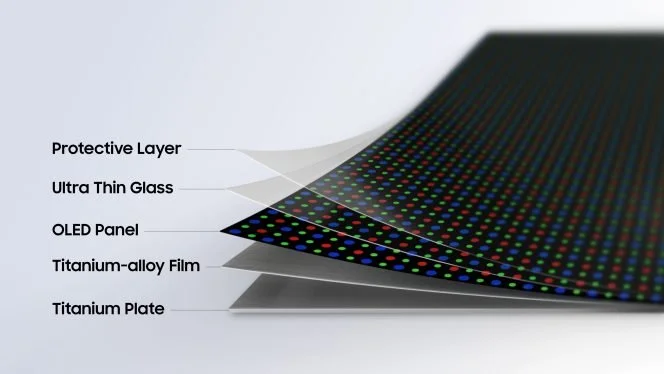
As shown in the official diagram, you have a protective layer on top, followed by an ultra thin glass layer. This is ultra thin glass, so it is not a standard pane of household window glass, but it is a true form of glass. Right below that sits the OLED panel itself, which is what you actually look at. Finally, we get to the two brand new additions: a titanium alloy film and a robust titanium plate sitting below it to give the display more rigidity.
Upgraded Screen Durability
This new setup will definitely make the crease less visible, but the massive leap in overall durability is what makes this incredibly exciting. Having a material as strong as titanium integrated into the display stack, even when it is incredibly thin, makes the entire panel much more durable. Foldable phones have gotten progressively less prone to spontaneous cracking down the middle as the technology has evolved. We heard about those cracking issues constantly back in the days of the Z Fold 2 and the original Pixel Fold, but the frequency has dropped significantly. With the Z Fold 8, those incidents should drop even further.
Samsung has historically made huge improvements to the folding hinge. If you fold a piece of paper very tightly with a sharp, creased bend, the paper suffers a lot of structural damage. If you instead fold that same paper into a teardrop shape with a wider radius, it curves gently without leaving a harsh crease. Phone manufacturers have successfully transitioned to this wider teardrop fold to protect the screen, but now Samsung is also tackling the issue from the inside of the display panel itself.
In the official press release, Samsung explains:
"Known for its resilience and strength, titanium has been used in some of the most demanding applications, including satellite antennas and the wheels of a Mars rover. While its strength makes titanium a dependable material, it also presents a significant engineering challenge when applied to the thin and flexible structure of a folding display due to its stiffness."
The Titanium Layers
To solve this stiffness challenge, Samsung split the titanium integration into two key components:
The titanium alloy film is a component that supports the display from within, sitting below the OLED panel. Compared with polymer film, it provides 20 times greater mechanical stiffness. A precision rolling process makes the material exceptionally thin, measuring roughly one-third the thickness of an average human hair, enabling a slimmer display panel.
If you look closely at older foldable display stacks, there used to be an additional layer that made the screen compatible with the S Pen. That layer has been removed here to keep the overall device thin and let Samsung focus entirely on panel durability. If stylus support comes back down the line, it will likely rely on an active stylus system like the ones used by Motorola.
Directly below that thin alloy film sits the second component:
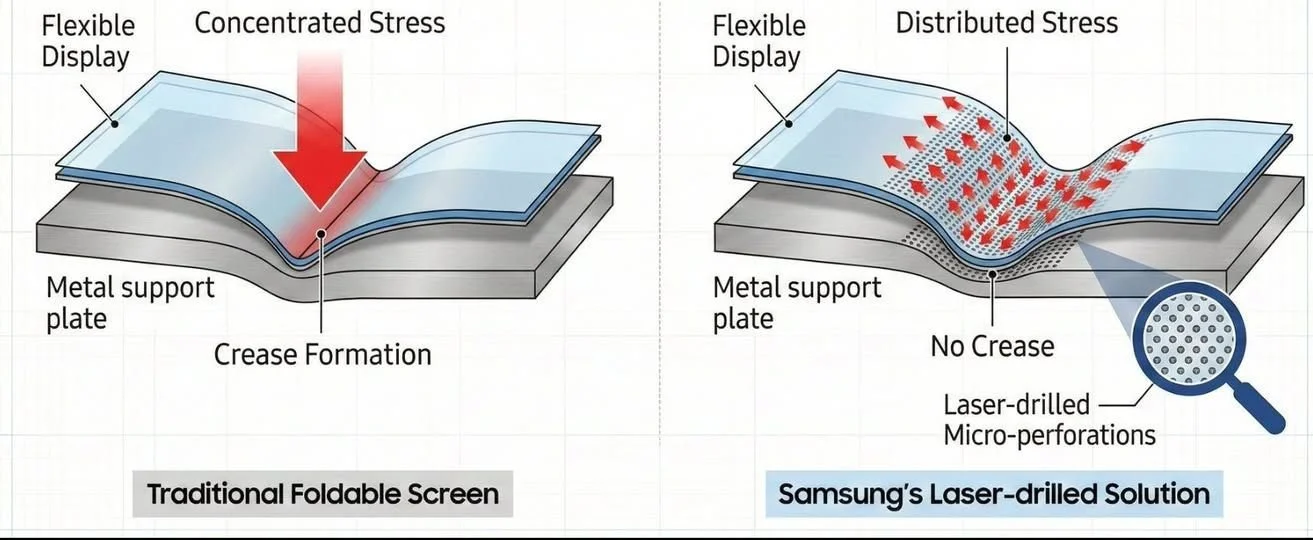
"Below this sits a robust titanium plate, a flexible structure that supports the display module from beneath. It allows tighter bonding with the display by eliminating air gaps between the module and the adhesive on the plate through advanced hole processing technology. This new structure provides more stable support underneath the display when unfolded while retaining the flexibility needed to accommodate repeated folding."
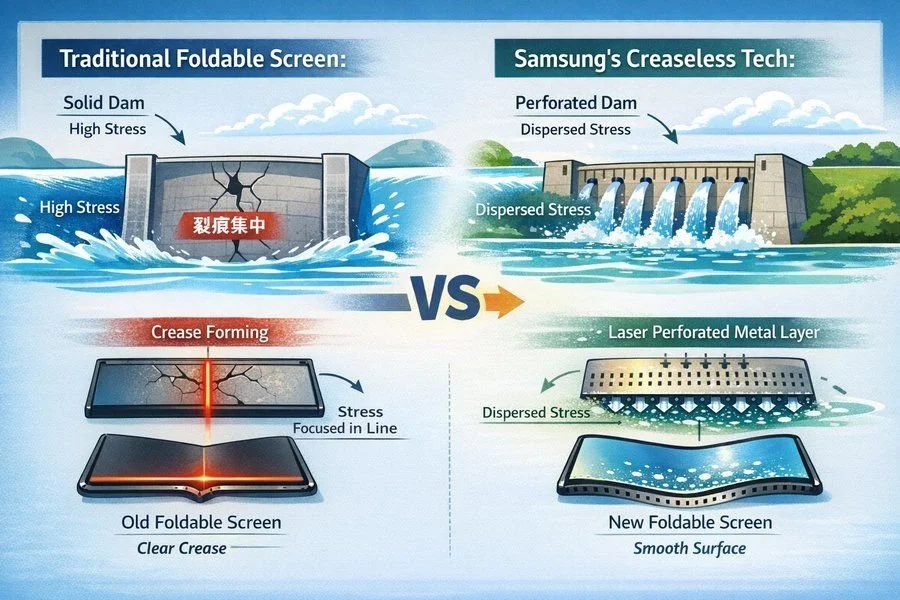
This bottom plate has tiny, micro-patterned holes punched into the folding section. This precise laser-hole pattern allows the metal plate to bend repeatedly without degrading over time. When you fold the screen, the stress is no longer concentrated in one tight, narrow line. Instead, the hole pattern helps distribute that physical stress along a much wider radius.
Real World Crease Comparison
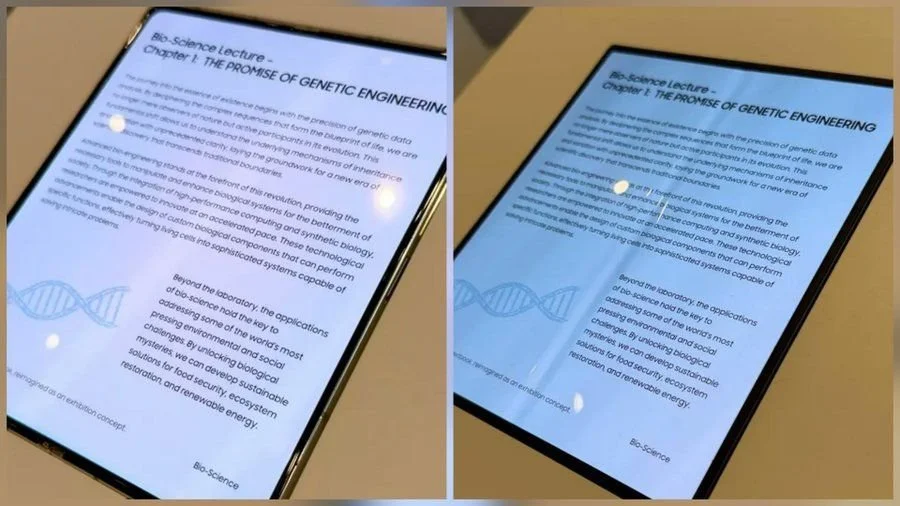
We can see this design progress by looking at previous generation devices. On a Z Fold 4, the crease is incredibly narrow, deep, and thin. On the newer Z Fold 7, the crease is much wider and shallower. If you look at something like the Motorola Razr, the crease is incredibly wide and shallow.
Some people complain that these wider creases are actually more visible in certain lighting conditions. There is a very specific engineering reason why manufacturers are doing this. They are intentionally distributing the bending stress over a larger surface area so you don't end up with physical display damage. My personal Z Fold 4 has a tiny crack right in the middle of the screen crease that has been there for years. The screen still functions perfectly fine, but that structural cracking is exactly what this new titanium stack is trying to prevent.
While the visual appearance of the crease is easy to ignore once you look straight at a screen, spontaneous cracking is a major headache. Utilizing titanium to spread out the stress means better durability and less risk of a spontaneous screen failure.
Samsung has pushed foldable display technology forward once again. Because Samsung supplies panels to other companies, we will likely see this exact technology show up in foldables from other brands, including whatever Apple eventually releases.