This Looks Really Bad for Motorola
UPDATE: Moto has officially addressed the issue and it has been fixed: https://shanecraig.tech/news/motos-bizarre-amazon-hijacking-issue-is-fixed
Over the last number of years, Motorola has gone through a massive glow-up. We watched their sales numbers steadily dip to the point that they basically exited the premium phone market altogether, choosing to focus temporarily on cheaper, budget-minded devices. Eventually, they re-entered the flagship ring with premium slab phones and the revived Razr foldable line, which have actually reviewed quite well and helped rebuild consumer trust in the brand.
Now, a bizarre technical mystery is threatening to erode that growing trust. Reports have surfaced across the Android community, backed by tech outlets like 9to5Google, showing that certain Motorola devices are actively hijacking the Amazon app to insert affiliate codes and collect unauthorized retail commissions.
The issue first came to light when a tech-savvy user shared a post on Reddit exposing a strange screen flicker while tapping the Amazon app icon on their flagship Razr 60 Ultra. Instead of launching the application smoothly, the phone briefly forced the default web browser to open, flashed a sketchy-looking redirect link, and only then deep-linked back into the official Amazon shopping interface. For the average user, it is a blink-and-you-miss-it moment easily dismissed as standard interface lag.
Breaking Down the Digital Paper Trail
When you analyze the logcat data during these hijacked launches, the technical data paints a precise picture of what is happening under the hood.
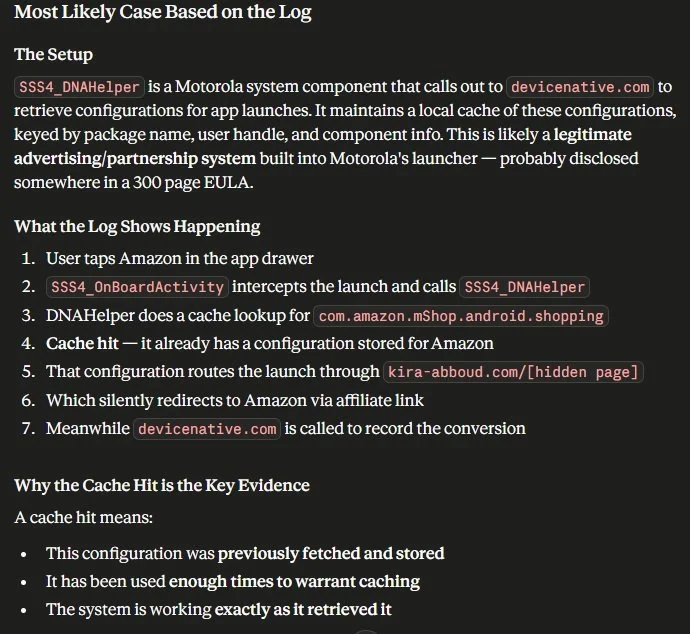
The moment you tap the Amazon icon in the app drawer, the system does not trigger the Amazon application file directly. Instead, an operating system listener intercepts the action. The logcat specifically references a background software component called DNAHelper. This is not a core Motorola utility, and instead, it is a specialized component belonging to DeviceNative, a white-label mobile advertising platform that specializes in delivering personalized, on-device ad placement for major hardware brands.
To be clear, the DeviceNative framework itself is not inherently malicious or a piece of clandestine malware. In a standard, non-nefarious setting, platforms like DeviceNative are completely normal commercial utilities used by hardware manufacturers to legally monetize their free software spaces. For example, when you swipe over to a discovery page, open a native widget, or scroll through the little integrated news feed that exists right inside Motorola's app drawer, a white-label ad SDK like this is usually what serves up those targeted headlines or localized shopping ads without exposing your personal information to external servers.
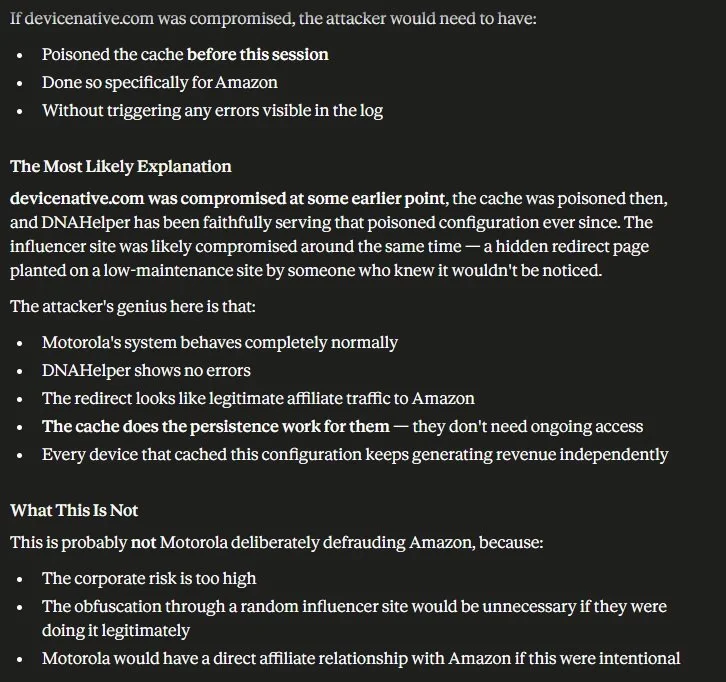
However, in this specific instance, it appears a standard corporate ad utility has been twisted into something completely rogue, likely due to a server-side breach or a malicious configuration push that essentially poisoned the platform's lookup system.
Instead of an attacker rewriting the app's code, they likely altered the remote configuration files that the ad SDK downloads to function. Platforms like DeviceNative rely on these cloud-hosted data tables to know which ads to display. When the local DNAHelper component on the phone calls home to devicenative.com, it downloads these layout rules and saves them into a local database cache. This is just my speculation, but I think that’s where the nefarious action took place.
If those remote tables are tampered with, the local cache becomes poisoned. The order of operations then transforms into a rogue pipeline:
You tap the Amazon app icon specifically inside the launcher app drawer.
The integrated DeviceNative SDK intercepts the intent before the app can open.
The DNAHelper component instantly queries its corrupted background cache to check if the target app matches its new, hijacked instructions.
Finding a forced match for a high-value retail app like Amazon, the system overrides your input and spawns a hidden background activity.
This activity generates a completely new command, forcing your default mobile browser to open a middleman web address.
The address used in the redirect routes through a domain called kira-abboud.com, which belongs to an online fashion influencer known as @kirasfashionfinds. The middleman site quickly drops an affiliate tracking cookie into your browser cache, and then the browser deep-links you back into the official Amazon app. To the retail platform, it looks like you clicked an advertisement link right before shopping, meaning whoever managed to manipulate that remote server data earns a financial commission on any purchase you make within the next 24 hours.
The Case for a Server-Side Exploit
The immediate reaction from frustrated users is to blame Motorola for deploying incredibly scummy, short-sighted bloatware to squeeze extra revenue out of users who just spent over $1,000 on a premium phone. However, a deeper look at the anomalies reveals a scenario where Motorola's core team isn't manually pushing this out, and instead, a critical part of their integrated ad ecosystem has likely been compromised at the data level.
If this were a corporate monetization scheme sanctioned by Motorola, it would not look like this. Corporate affiliate partnerships are handled via clean, direct contracts with major networks. They do not route traffic through a random fashion blogger's domain. Furthermore, 9to5Google discovered that the specific affiliate code injected by the phone does not even match the tracking codes that the influencer actually uses on her public social media channels. All this points towards DeviceNative being compromised and this random fashion influencer’s site being used as a patsy.
In sophisticated ad fraud operations, threat actors rarely route stolen traffic through freshly registered, suspicious-looking domains that automated network firewalls would instantly block. Instead, they compromise an existing, legitimate third-party website to use as a "patsy." By tucking a hidden redirect page deep inside a valid fashion blog, the automated security scanners utilized by ad networks see standard, innocent lifestyle traffic. The attackers sit comfortably in the middle, using nested sub-accounts to harvest the siphoned retail payouts while leaving the innocent website owner to take the blame if the redirect is caught.
The Fallout for Motorola
Even though the evidence strongly suggests a third-party malicious actor is responsible for breaching the ecosystem, this remains an absolute disaster for Motorola. When consumers buy a flagship phone, they expect the underlying system software to be incredibly secure. Finding out that a preinstalled, hidden ad platform integration was left vulnerable enough to allow a supply chain attack to hijack basic user inputs completely shatters that consumer confidence.
While the community waits for an official security patch or a statement from the engineering teams, affected users can shut the entire pipeline down manually. Because the DeviceNative framework relies on Motorola's preinstalled Smart Feed application container to handle its system-level interactions, cutting off the host app instantly kills the exploit.
If you notice your device flickering or launching a web browser when you try to open retail apps, you can stop the loop by navigating to your device settings, opening the apps menu, selecting the option to view all apps, searching for Smart Feed, and tapping Disable. Turning this off stops the interception entirely, restoring direct routing to your applications without impacting your app drawer or device functionality.