Why Wider Foldables Are What We Needed
With CAD renders of the Galaxy Z Fold 8 "Wide" variant leaking from reliable sources, we now have near confirmation that Samsung is finally shifting to a 4:3 aspect ratio. It is a massive departure from the narrow, remote-control-shaped foldables we have lived with for years, and it signals a fundamental change in how these devices are intended to be used.
This shift is leading many people to ask why they would even want this. When you look at the renders, the "Wide" variant looks remarkably like a standard Fold 7 or 8 with the top inch or so simply cut off. It raises a fair question: what is the benefit of having less vertical screen? If you are losing total surface area, how is that an upgrade?
The answer lies in understanding that screen utility is not just about raw size. We've been conditioned to think bigger is always better, but with a screen, the shape of the canvas often matters more than the raw acreage. I have always viewed aspect ratios as a gradient. At one extreme, you have the tall 9:16 rectangle, which is perfect for scrolling through endless soul-crushing social feeds. At the other, you have the 16:9 widescreen, the undisputed king of movies and media. Most foldables have tried to split the difference with a square inner display, but by trying to be a middle ground, they ended up in “master of none” territory. A square isn’t bad at the average vertically oriented app or consuming media, but it’s not great at it either. Social apps tend to look awkwardly stretched out and movies are flanked by massive black bars. The lone thing squares are really great at is splitting two standard phone apps side-by-side.
This is why I am so excited about the shift toward a wider, "Passport" style form factor. It is all about flexibility and intended use. For productivity-minded people, a square makes sense for split-screening a a website and your notes app, but if we’re honest, most people just want to consume media on that larger screen. A form factor that is shorter and wider communicates to the user: "This is for media."
And if you need to use one of those vertically oriented apps that there are so many of, rotating a 4:3 device will get you a better form factor for exactly that vs a square. Rather than a “master of none,” you get a device that’s pretty great at media and scrolling.
On a square screen, new dual-panel apps are certainly a step up, but depending on their layout, they can end up feel quite cramped. I run into this with Gmail all the time. The dual-pane view is there, but I usually ignore it because the interface feels too tight to be productive. Expanding to a 4:3 ratio gives those side-by-side elements the breathing room they need to feel intentional rather than cramped. Given the right app support, I believe 4:3 can be more productive too. A 4:3 screen cut into two halves for split screening won’t be as good as a square, but the two “screens” you get are tall enough for multitasking to still be useful. Toss in dual-panel apps and I think we’ve got a better mix of strengths vs a square.
For media, less letterboxing. For dual-panel apps, more room to work. For traditional apps, rotate it and you’re better off vs a square.
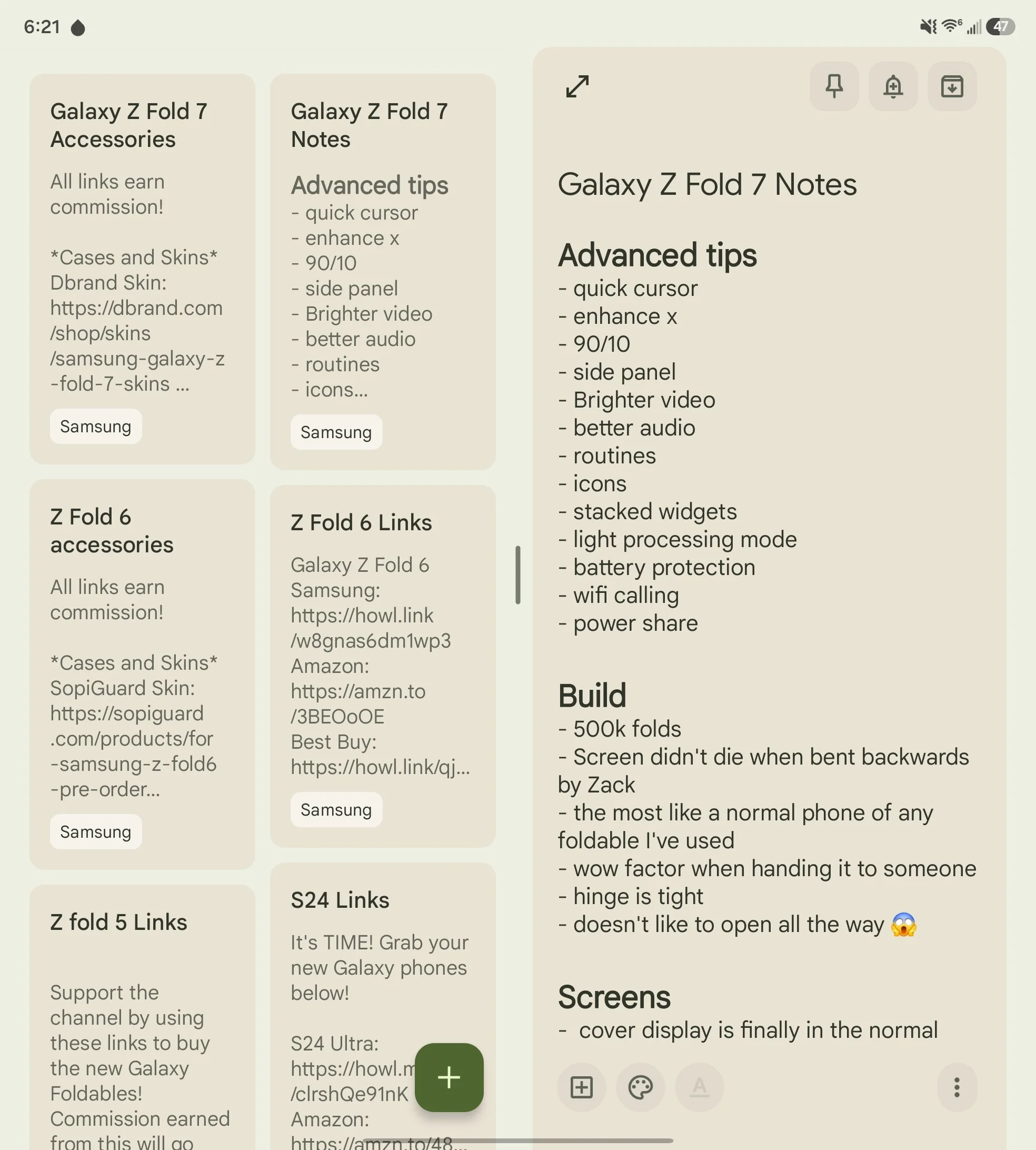
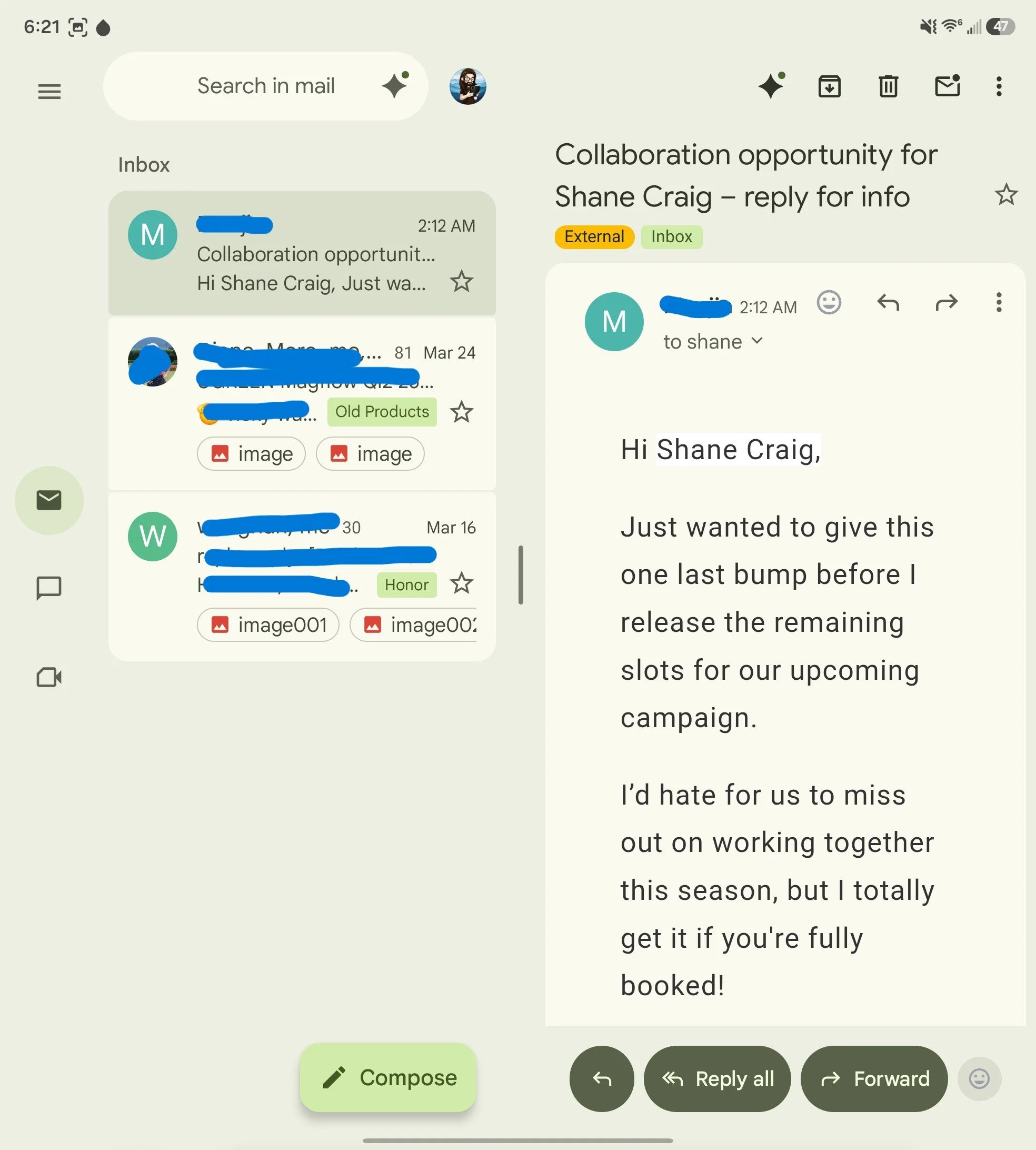
It is easy to see how we arrived at our current square state. A square seemed like a logical choice because it is basically the halfway point between the verticality of a phone and the horizontality of a TV. It also allowed the cover display to maintain the proportions of a "normal" smartphone. But in our quest for a perfect hybrid, we might have wandered into the wrong territory. Moving the needle back toward 16:9 and landing at 4:3 feels like a much more thoughtful compromise. It recognizes that once we unfold the phone, our brain shifts from "phone mode" to "tablet mode."
This mental shift is where current foldables often fall short. When you open a standard Fold, you are essentially just moving from a narrow phone to a wider version of that same phone. It does not feel like a true, transformative change. It is just "phone to bigger phone." By widening the chassis, you change the experience to "phone to tablet." A 4:3 screen feels like a separate class of device, with an entirely different use case, providing that "wow" factor that actually justifies the folding mechanism. It feels like you are opening a book or a canvas rather than just stretching a handset.
We also have to consider why a 16:9 foldable doesn't make sense. If the inner screen were that wide, the cover display and any split-screen apps would end up being too squared off. A 960 by 1080 window would be bad at almost everything, leaving you with a phone that often feels awkward to use. Imagine trying to type on that thing. Closed, the keyboard would occlude a huge chunk of the screen and opened would just as bad. Imagine trying to use the Clicks Communicator without the keyboard below the screen.
I’ve gotten several comments about how split-screen is fine on a PC monitor, so it would be fine on this hypothetical device too, but that just isn’t the case. On a typical desktop monitor, 16:9 gives you enough raw screen real estate that splitting the screen still leaves you with two functional “windows.” On a mobile device, those same physics don't apply. On a 7 or 8-inch mobile device, splitting a 16:9 screen doesn't give you two functional workspaces, it gives you two small, awkward squares. Because Android apps generally aren't built with a square aspect ratio in mind, most of them won’t be a fun experience. If you force the app to trigger a tablet layout, you’ll end up with an extremely cramped UI because there isn't enough horizontal room for the multi-pane interface to breathe. If you stick to a phone layout, the UI is going to be short and stretched as it is forced into this boxy container it was never designed for. In my content about the square-screened keyboard phones gaining popularity, I cite their aspect ratio as a proven deterrent of doom scrolling. Most apps are so awkward to use on these devices, the result is a “detox” of sorts. You use the phone as a tool and rarely get lost in it.
I highly doubt this is the experience most users want for the cover screen or for split-screening on their next foldable.
Other Concerns
Another cause for pushback centers on the cover screen. People have spent years getting used to the candy bar slab feel and they worry that a wider device will be harder to use one-handed, but we have to remember the "Wide" variant is also shorter than the standard model. While it is slightly wider in the palm, it is also more compact vertically. Your thumb doesn't have nearly as long a distance to travel to the notification shade or the controls often placed at the top of apps. With similar devices like the original Pixel Fold, many of us found one-handed use to be easier vs the taller, more narrow slabs.
As long as we stick to narrow slabs and stretched-out squares, developers have little reason to do the extra work. But a proliferation of 4:3 devices could finally give them a target that makes sense. Google has been pushing an "adaptive future" with Android 16 and 17, where apps are supposed to flow seamlessly between phone and tablet views. A series of 4:3 foldables could be the catalyst that forces that transition.
There is also the inevitable question of pocketability. Whenever you hear "Wide" in a phone name, the immediate mental image is a bulky brick that won't fit in your pocket. But as long as the weight stays low, which is less and less of an issue with modern materials, the width shouldn't be much of a problem. In reality, it is not that much wider than a normal flagship slab. If you, like I, were okay with the footprint of the Surface Duo or original Pixel Fold, this should be fine. It is a trade-off I am more than willing to make if it means I am looking at a legitimate tablet instead of just a slightly larger phone.