iPhone Duo vs Galaxy Z Fold 8 - Early Tale of the Tape
Apple finally did it. The company unveiled its very first foldable phone, the iPhone Duo, and the internet immediately reacted with the usual mountain of hype. Whenever Apple enters a category that Android makers have inhabited for almost a decade, the hyperbole goes through the roof. We are sitting on the Samsung Galaxy Z Fold 8 right now, so foldable hardware is mature, refined, and familiar territory. Instead of getting swept up in the whirlwind, it makes sense to look at this comparison reasonably from a high level, break down the numbers, and see where these two devices actually stand against each other.
iPhone Duo is a relatively accurate 3D print
Dimensions and Physical Design
Thickness and weight are often secondary details, but on a book-style foldable, they fundamentally shape how the device feels in your hand every single day. The iPhone Duo measures 5.2mm thick when unfolded, while the Galaxy Z Fold 8 comes in at just 4.5mm. When it comes to mass, the iPhone Duo registers at 254g, whereas the Z Fold 8 sits comfortably at 201g. Apple is landing much closer to the heavier end of the spectrum alongside devices like the Pixel Fold rather than matching Samsung's ultra-light engineering. Some of that extra weight likely stems from the internal MagSafe magnet array, a potentially larger battery, or cooling hardware, but if you prioritize the thinnest and lightest footprint, Samsung clearly holds the lead.
The overall exterior aesthetic is also quite different. The iPhone Duo features a notably asymmetrical look when closed, with one sharp edge near the hinge and very rounded outer corners designed to make the unfolded silhouette look uniform. Subjectively, that cover screen shape looks a bit unusual. Samsung has managed to conceal its hinge geometry so well over eight generations that the Z Fold 8 looks remarkably balanced whether it is shut or open.
Physical ports also show a split in philosophy. The iPhone Duo is strictly eSIM only, ditching the physical tray entirely. The Galaxy Z Fold 8 still retains a physical SIM slot. For anyone who swaps phones constantly and wants to move a tray tool between hardware in seconds without carrier intervention, keeping that physical slot remains a tangible practical advantage.
Displays and the Crease Debate
Both devices center around 7.6-inch internal displays with 4:3 aspect ratios and peak brightness ratings reaching up to 3,000 nits. Real-world direct sunlight viewing matters far more than laboratory peak nit numbers, but on paper the panels share very similar dimensions. Apple does edge out Samsung slightly in pixel density across both the inner panel and the cover screen, offering 460 PPI compared to 428 PPI on the Fold.
The surface finish is where the approaches diverge. Samsung treated the inner screen of the Z Fold 8 with a solid anti-reflective coating that drastically cuts down glare outdoors. Apple went a step further by using a full matte nano-texture finish across the folding display. That surface dramatically reduces ambient reflections and visually masks the hinge seam, though matte textures historically introduce slight compromises to color vibrance and accuracy. As for the crease itself, social media feeds have made it clear that the iPhone Duo is definitely not creaseless. Just like the Fold 8, the crease is minimal, refined, and largely irrelevant once you are actively viewing content.
Cameras and Sound Hardware
Looking at primary camera hardware, Apple went with a 48MP main sensor sized at 1/1.28-inch with 1.22-micrometer pixels. Samsung opted for a 50MP sensor measuring 1/1.56-inch with 1.0-micrometer pixels. Apple has the larger physical sensor here, which on paper provides better light gathering capability and cleaner digital crop zoom, even if day-to-day point-and-shoot quality will come down heavily to computational processing. The ultrawide modules are functionally comparable at 48MP each with near-identical specs, and neither phone includes a dedicated telephoto lens.
Audio architecture reveals an important ergonomic detail. The iPhone Duo positions its stereo speakers at the top and bottom on opposing halves, which delivers a true left-and-right stereo separation whether you hold the device in portrait or landscape. Samsung continues to place both of its stereo speakers along the left frame when unfolded, meaning that audio perception can feel noticeably biased toward one side when holding the screen open.
Biometrics, Selfies, and Styling
Biometrics on the iPhone Duo appear to rely entirely on a side-mounted capacitive fingerprint scanner built into the power button rather than Face ID. The Fold 8 similarly uses a power-key fingerprint sensor, though it includes an optional standard front-camera face unlock option as a secondary convenience.
For the internal camera, Samsung stuck with a standard hole-punch cutout. Apple implemented an under-display camera (UDC) on the folding screen, hiding the lens beneath active pixels. Under-display cameras can sometimes produce a shimmering grid over bright backgrounds or struggle with camera clarity, so real-world testing will reveal how clean Apple's optical implementation looks. Notably, the matte nano-texture coating does not cover the tiny circle directly over Apple's hidden camera lens, leaving a small glossy patch near the top edge.
Software, Stylus Support, and Multitasking
Apple brought its signature visual polish to the software experience, adding smooth blur transitions as the display unfolds and adapting several stock applications for the wider format. However, simply shifting icons to one edge of the screen is not the same as building true dual-pane tablet interfaces from the ground up, an area where Android developers and Samsung have spent years refining dedicated split layouts.
A major win for Apple is confirmed future support for the Apple Pencil across both the internal display and the outer cover screen. Foldables offer a pocketable canvas that naturally benefits from stylus input. Samsung pioneered the category with the S Pen, but removed the internal digitizer layer on recent models to trim thickness and has yet to bring an active multi-screen stylus to market for the Fold line. Apple managing to introduce dual-screen pencil compatibility before Samsung is a significant milestone.
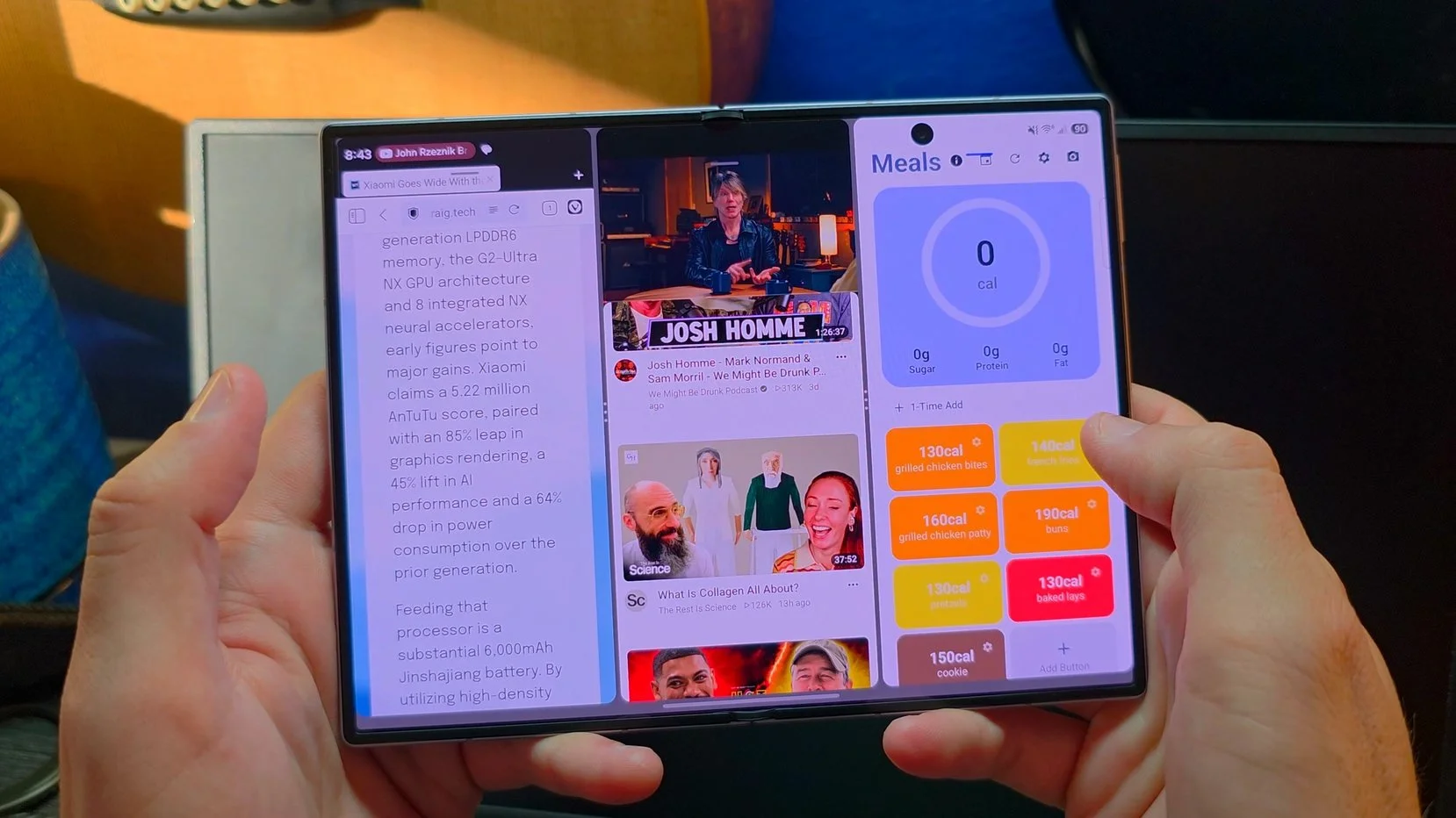
Samsung counters strongly on raw software productivity. One UI on the Z Fold 8 allows you to run more than two apps simultaneously in split-screen, open endless floating pop-up windows, and launch Samsung DeX to turn the device into a complete desktop workstation over a monitor cable or wireless connection. Those advanced workflow tools remain completely unmatched by standard iOS interfaces.
Competition in this space is fundamentally healthy. Having Apple enter the folding category brings broader mainstream attention, pushes display suppliers to innovate, and puts pressure on Samsung to keep refining hardware features like stylus integration and camera cutouts on future iterations.