The Galaxy Z Fold 8's New Battery Might Be Better Than You Think
For years, Samsung has played a conservative game with its foldable battery life. Even with the release of the Galaxy Z Fold 7 last year, the company stuck to that familiar 4,400mAh capacity, a number they've relied on since the Fold 3. While Samsung points to the efficiency of the Snapdragon 8 Elite "for Galaxy" and deep software optimization as the reason for the status quo, the criticism from users and reviewers has only grown louder.
It’s hard to ignore the landscape when Google has pushed into the 5,000mAh range and Chinese brands are hitting 6,000+mAh with dual-silicon technology. The Fold 7 is a refined device, but for many, it felt like the battery was left in the past. Now, however, the latest word from the rumor mill suggests Samsung is finally ready to break the cycle. The Galaxy Z Fold 8 is reportedly jumping to a 5,000mAh cell, marking the first significant capacity upgrade in the history of the lineup.
To a tech enthusiast looking purely at the spec sheet, that 5,000mAh number for the Galaxy Z Fold 8 might still sound a little lackluster. It is a sentiment echoed regarding the charging speeds: while moving to 45W charging is a welcome improvement over the older 25W cap, it still seems slow compared to the 80W+ solutions found on Chinese rivals. For many, this will be perceived as a letdown, raising the question: "Is Samsung still just trying to do the bare minimum?" To be fair to those with that perspective, the answer is to that is probably “yes.”
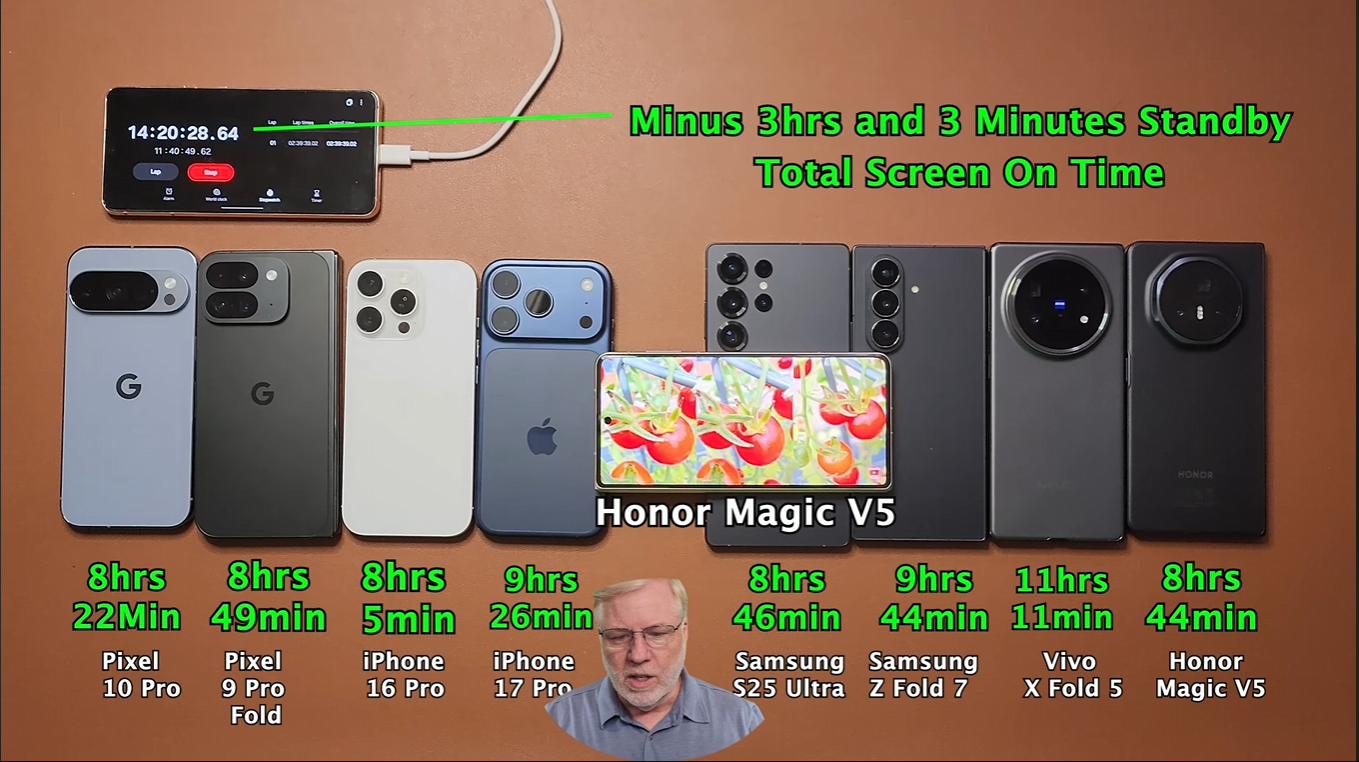
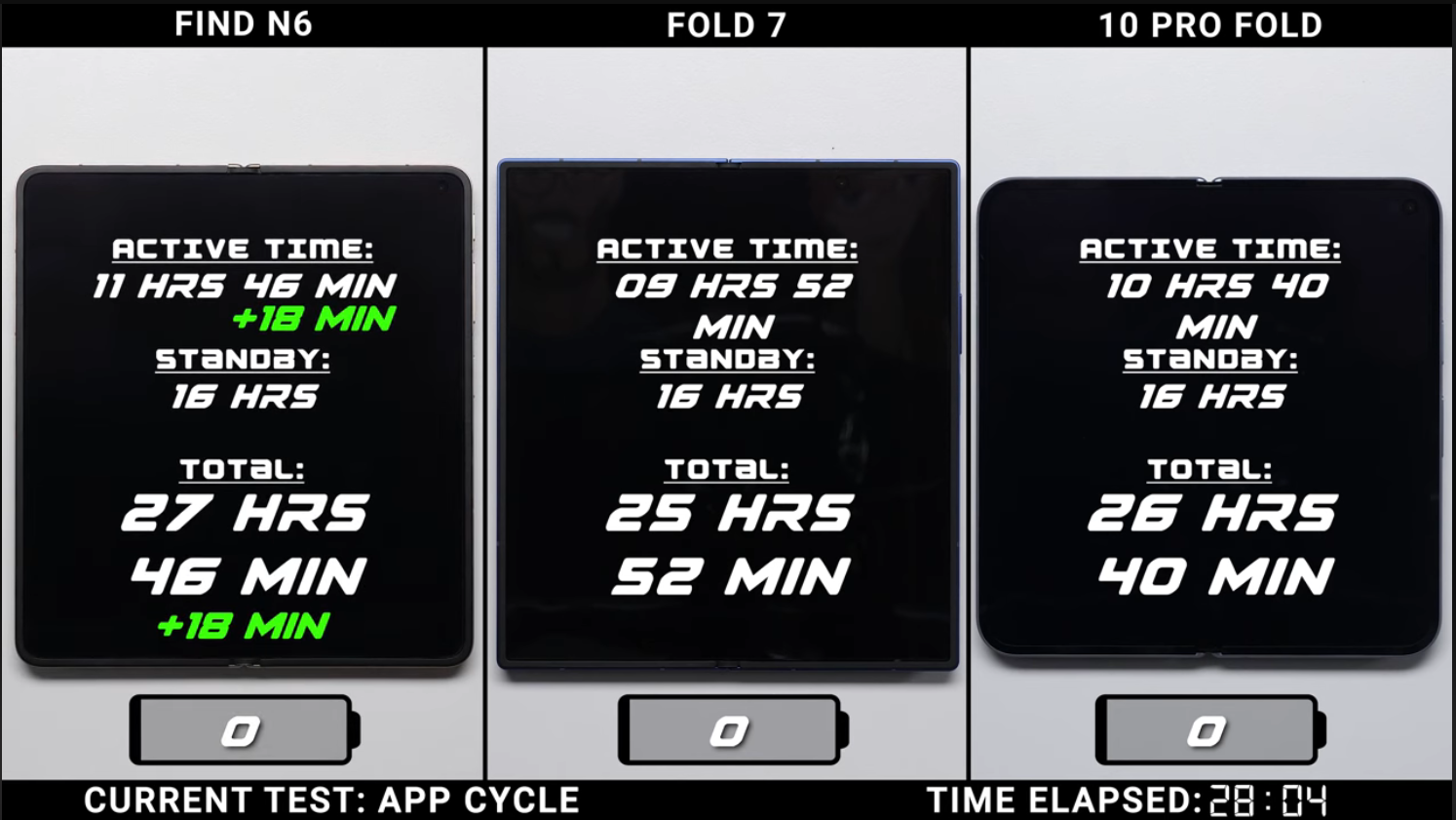
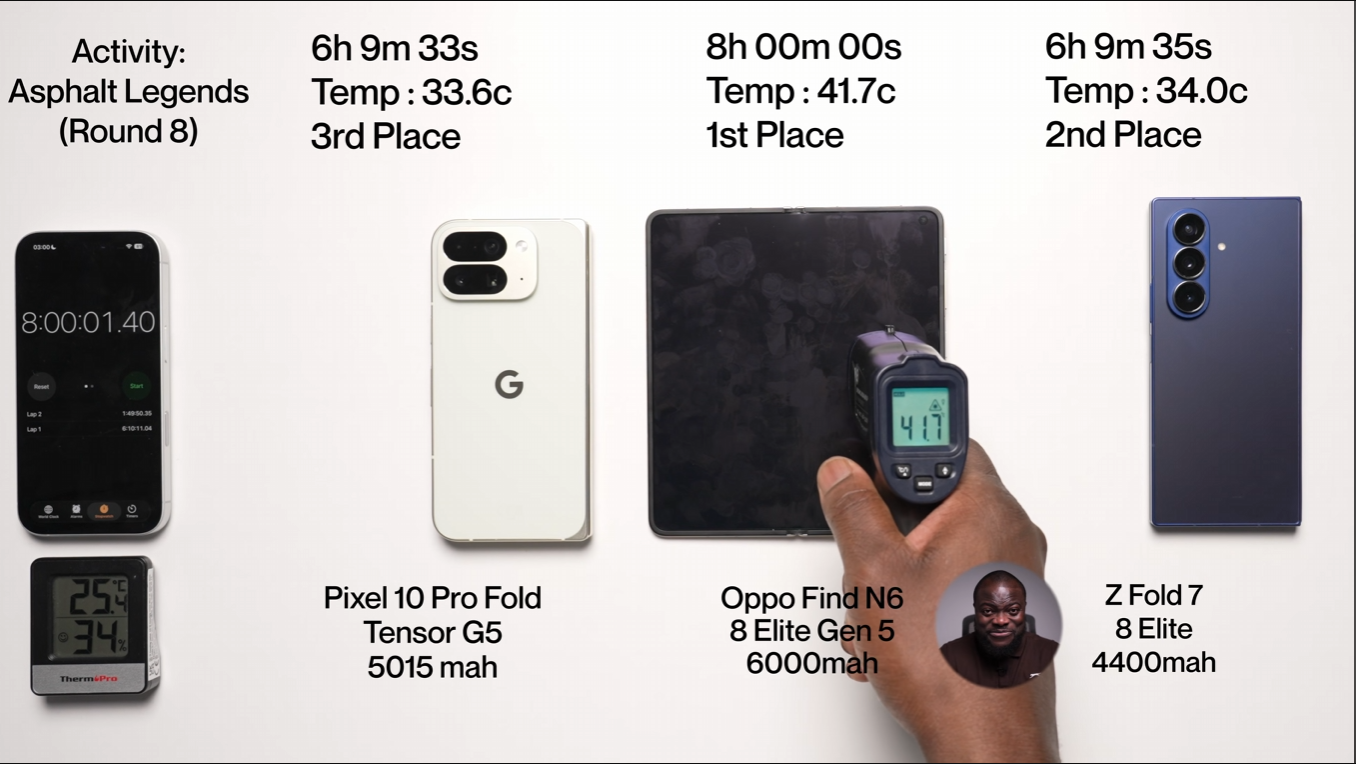
However, I’ve been digging through battery drain tests across YouTube, and the data tells a story that the spec sheet misses. When you look at the results of many of these head-to-head comparisons the Galaxy Z Fold 7 performs surprisingly well for a device with a 4,400 mAh battery.
The first screenshot shows a head-to-head total screen-on-time test that illustrates how these numbers don't always scale linearly. What stands out here is that the Galaxy Z Fold 7, even with its small 4,400mAh battery, managed 9 hours 44 minutes of active use. This actually beats out the Pixel 10 Pro and its 4870mAh cell. It even bests the 5,150mAh battery in the Honor Magic V3 (labeled incorrectly as the V5 on the far right). While the 6,000mAh monster in the Vivo X Fold 5 eventually pulls ahead, the gap in performance is nowhere near the 36% gap in raw battery size.
The second screenshot provides a breakdown of active versus standby time after hours of dynamic testing. The Oppo Find N6 is the clear leader here with 11 hours 46 minutes of active time, but again, look at the scaling. The Oppo battery is 36% larger than the Samsung one, yet it only provided about 20% more active runtime. For comparison, the gap between the Oppo and the Pixel 10 Pro Fold is even further from linear. The Oppo has about 20% more capacity than the Pixel, yet it only provided 10% more runtime. This suggests that while Google and Oppo are essentially relying on massive batteries to brute force their way to the top, Samsung is indeed getting more out of every milliamp than its peers. In fact, when you break it down to runtime per 100mAh, Samsung is getting 13.5 minutes of active use compared to the Pixel at 12.8 minutes and the Oppo at just 12 minutes.
The third screenshot highlights a likely reason for this: thermal management. During this high-drain round, the Fold 7 stayed relatively cool at 34.0°C. In comparison, the Oppo Find N6 was a whopping 41.7°C. Heat is the enemy of battery life, and by keeping temperatures low, Samsung is doing itself a big favor. In this test, Samsung’s Fold bests Google’s Pixel despite the Pixel having a 14% larger battery. If we go back to our “minutes-per-100mAh” rubric on this test, the efficiency story remains the same. The Z Fold 7 is pulling 8.4 minutes for every 100mAh, while the Oppo Find N6 follows with 8.0 minutes and the Pixel 10 Pro Fold trails at just 7.4 minutes.
When we look at the Galaxy Z Fold 7 with its 4,400mAh battery, it consistently goes toe-to-toe with or even slightly outperforms devices that already have a 5,000mAh capacity. Following this pattern, the jump to a 5,000mAh battery in the Galaxy Z Fold 8 could be more impactful than you might expect. The Z Fold 8 will carry more juice and it will be powered by the Snapdragon 8 Elite Gen 5 for Galaxy. Early reports on this chip suggest it brings a 35% improvement in CPU efficiency and a 20% reduction in GPU power consumption. When you pair that level of optimization with a 14% larger battery, this phone could start to approach the endurance of those 6,000mAh Chinese foldables.
All this being said, I have used both the Galaxy Z Fold 7 and the Pixel 10 Pro Fold extensively, and in my own daily testing, the Pixel 10 Pro Fold consistently comes out on top in my use. This shows that with any battery test, things are always going to be imperfect. You cannot expect to get exactly what a particular lab or YouTube test shows because those scenarios do not perfectly replicate your day-to-day life. There are so many variables ranging from signal strength and screen brightness to the specific apps you use.
We cannot necessarily look at this data and be 100% sure of the outcome, but there is enough good data here to at least be more optimistic than you might have been otherwise. If Samsung is already this close to the Pixel while having a 14% smaller battery, then the Z Fold 8 with its 5,000mAh cell might be a pleasant surprise.
I must give a shout-out to friend of the channel B Floyd for some inspiration on this subject. I’d be lying if I said some recent conversations didn’t influence this being written.