The Moto Razr Isn't "Elite," And That's Fine
You guys know that the Moto Razr Plus 2025 was a bit of a surprise hit for me. I bought it kind of on a whim in preparation for the Moto Razr Fold. I wanted to get some experience with Hello UI and see if that version of Android was going to be good enough, and it definitely pointed me in the right direction.
But one big thing about that device that I did not like, and I talked about it in my video, was the thermals. This thing just gets weirdly hot when you're charging it, when you're just using it for 10 or 15 minutes, and especially when you're outside taking photos. My wife, who also has a pink one, has echoed the exact same experience. In fact, the other day she came home after charging it on her drive from work and handed it to me, and I swear it felt like it was going to burst into flames.
Because of that, I was a little bit worried that the Razr Fold would have similar thermal issues. But in my early experience, I'm about a week in now, I've been really pleasantly surprised. I've been taking lots of photos outside with this device while holding other foldables in my other hand, doing side-by-side comparisons. It's in the mid-80s most days right now here in Knoxville, and what I've noticed is that while the foldables in my left hand begin to feel quite warm, the Razr Fold stays much cooler to the touch.
A lot of you know that this device has a slightly cut-down processor compared to some of the other foldables on the market. Instead of the Elite version, it’s running the standard Snapdragon 8 Gen 5. A lot of people naturally thought, "Oh, well, it's going to be slower." Well, it's not really feeling slower, but it is feeling cooler. I thought it might be fun to dig into this, run some benchmarks, and see if the data bears out my real-world experience.
The 3DMark Wild Life Extreme Stress Test
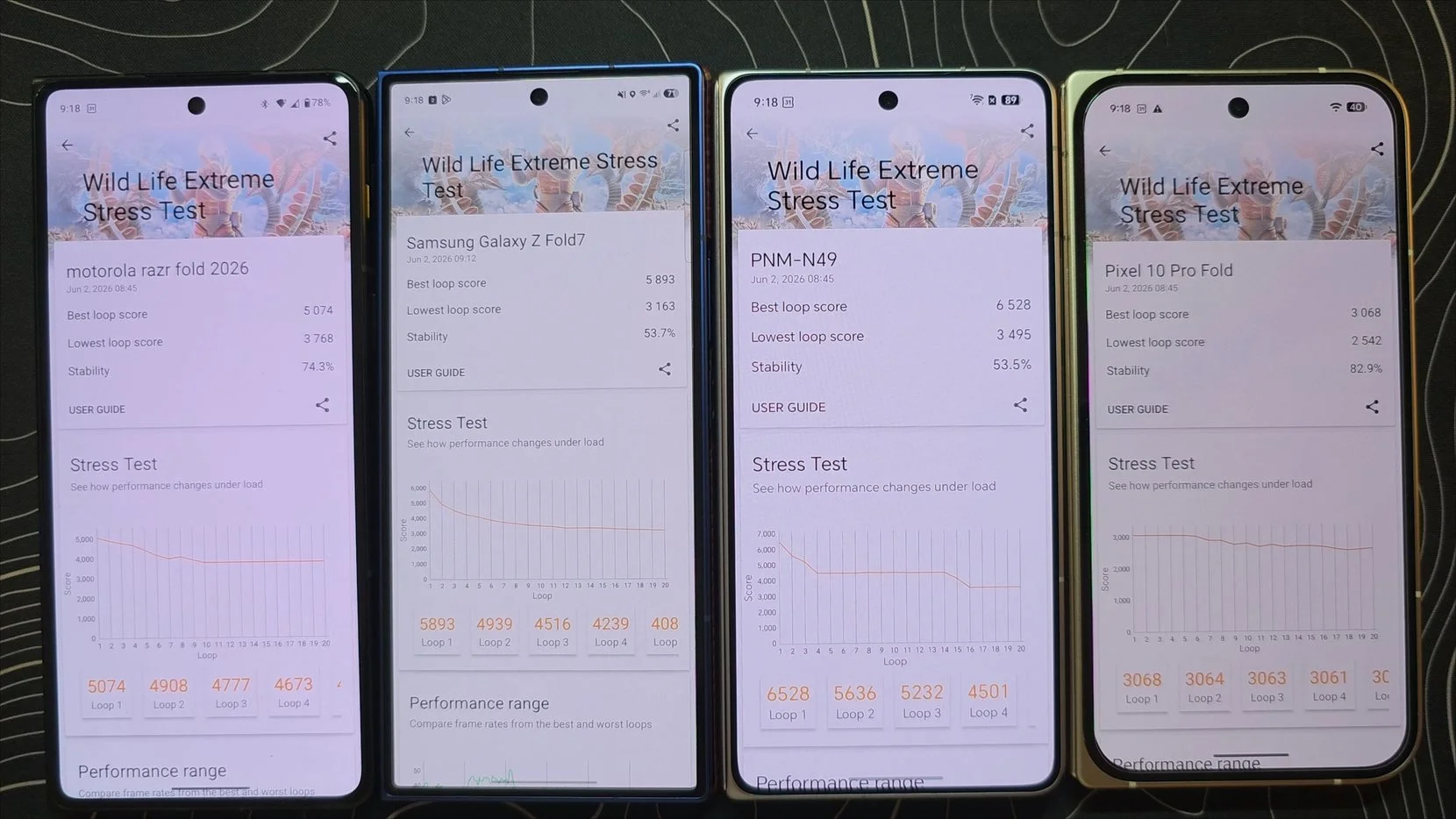
I lined up four devices side-by-side and ran the 3DMark Wild Life Extreme Stress Test, which runs 20 continuous loops over a 20-minute period to see how performance throttles under a heavy thermal load. Going from left to right, we have the motorola razr fold 2026, the Samsung Galaxy Z Fold7, the Honor Magic V6 (labeled here as PNM-N49), and the Pixel 10 Pro Fold.
Here is exactly how the numbers shook out:
| Device | Best Loop Score | Lowest Loop Score | Stability Rating |
|---|---|---|---|
| Honor Magic V6 | 6,528 | 3,495 | 53.5% |
| Samsung Galaxy Z Fold7 | 5,893 | 3,163 | 53.7% |
| motorola razr fold 2026 | 5,074 | 3,768 | 74.3% |
| Pixel 10 Pro Fold | 3,068 | 2,542 | 82.9% |
DeviceBest Loop ScoreLowest Loop ScoreStability RatingHonor Magic V66,5283,49553.5%Samsung Galaxy Z Fold75,8933,16353.7%motorola razr fold 20265,0743,76874.3%Pixel 10 Pro Fold3,0682,54282.9%
The Takeaways from the Data
The Peak vs. The Floor: Looking at the Best Loop Score, the Honor Magic V6 predictably comes out on top at 6,528 thanks to its newer hardware, while the Pixel 10 Pro Fold comes in dead last at 3,068. The Razr Fold and the Z Fold7 start about 800 points apart.
The Sustained Winner: This is where my real-world experience is totally validated. Look at the Lowest Loop Score. Shockingly, the Moto Razr Fold won this category at 3,768. It completely out-sustained the Galaxy Z Fold7 (3,163) and even beat out the peak-heavy Honor Magic V6 (3,495).
Real Stability: The Razr Fold managed an impressive 74.3% stability. Meanwhile, the heavy-hitting Elite processors in the Samsung and Honor devices completely plummeted into the 53% range. If you look at the graphs on the screens, you can watch the Elite-powered devices start sky-high and instantly nose-dive. Credit where credit is due, Google's Pixel is incredibly stable at 82.9%, but the problem is it starts low and just stays low.
(Note: The Razr Fold was the only device with an active SIM card in it during this run, which might have contributed to a tiny bit more battery drain and a peak temp of 41°C, but it still absolutely crushed the sustained performance metrics).
Light Mode & Third-Party Validation
Something else quite interesting: when I first ran this test, I didn't realize I had my Z Fold7 set to "Light Processing Mode." In light mode, the Z Fold7 acts a lot more like the Razr Fold, lowering the peak ceiling to preserve battery and keep thermals down (dropping to around 38°C). I almost exclusively run my personal Z Fold7 in light mode because day-to-day performance feels identical anyway. But looking at these unrestricted benchmarks, the standard Razr Fold actually tops the performance that the Z Fold7 delivers when it's throttled or in light mode.
Shout out to Timothy for emailing me an article that completely slipped through my filters, because Android Authority conducted their own independent benchmark testing and came away with very similar findings.
In their Geekbench testing, the Razr Fold nipped right at the heels of the Z Fold7, and both absolutely trashed the Tensor chip inside the Pixel 10 Pro Fold. In their Wild Life Extreme run, their Razr Fold peaked at a slightly cooler 38°C (there are always minor environmental variables), but the trajectory was identical: the Z Fold7 started higher, immediately plummeted, and the Razr Fold consistently beat it through the majority of the remaining test loops. They saw the exact same behavior in the Solar Bay test.
Real-World Use vs. Spec Chasing
In my recent comparison video between the Z Fold7 and the Moto Razr Fold, there’s a moment where I just launch apps side-by-side. I had a few people in the comments say, "That test is pointless, of course they are going to launch apps at the exact same speed." To which I say: Yes! That was entirely my point.
As a tech community, foldable users are notorious spec chasers. We want those top-end marketing names, but we often lose sight of actual real-world use. Think of it like football: it’s the difference between a player with incredible initial quickness and burst versus a player with great long speed. That long speed is a lot more useful when you actually have to run a long distance.
Would you rather have a device with a massive peak score that it can only maintain for two minutes before choking, or a device that sits just below that peak but maintains a higher, cooler, and more stable experience over a long duration? To me, consistency wins.
If you see that the Razr Fold doesn't have the "Elite" branding on the chip and you’re worried it’s going to be slow or laggy, you can comfortably take that notion and throw it away. In long-duration scenarios, like rendering a video or just taking photos outside in the summer heat, your experience is going to line up with mine: the Razr Fold stays cooler and holds its ground.