Could the Moto Razr Flex Be a Sub-$1,500 Missing Link Between Flips and Folds?
When early reports first started circulating about the original Moto Razr Fold, leakster Evan Blass initially pointed toward a $1,500 target price tag. That figure matched up with what I was hearing behind the scenes, including conversations with someone working in retail who noted that $1,500 was the exact price point they had heard as well. It sounded like the magic entry point the market desperately needed, giving us a full-sized book-style foldable priced aggressively enough to genuinely disrupt the $1,899 baseline anchored by devices like the Galaxy Z Fold 8.
As supply chain pressures mounted and raw component costs soared, Motorola was effectively forced to land the Razr Fold at $1,899. They delivered a powerhouse device, but the dream of a mainstream, affordable foldable was put on hold while ultra-premium devices and multi-fold experiments continued to push the high end of the market.
Only a handful of months after the Razr Fold was released, it looks like Motorola is set to enter the foldable market once again with an entirely different design.
Before the original Razr Fold was announced, Motorola sent out media care packages to select journalists. Inside was a physical wooden notebook shaped with the exact short, wide proportions of a passport phone. That gesture set off widespread expectations that Motorola was preparing to drop a passport-style device. When the actual launch happened, they surprised everyone by delivering a taller, candy bar style phone that unfolded into a standard square inner display instead, leaving that passport concept on the shelf.
Now, with the rumored Razr Flex, Motorola looks ready to finally fulfill that original tease. The specifications surfacing around this compact foldable suggest Motorola isn't trying to out-spec ultra-flagships. They are executing a targeted bill-of-materials surgical strike to bring a wide-aspect foldable down to a radically lower tier.
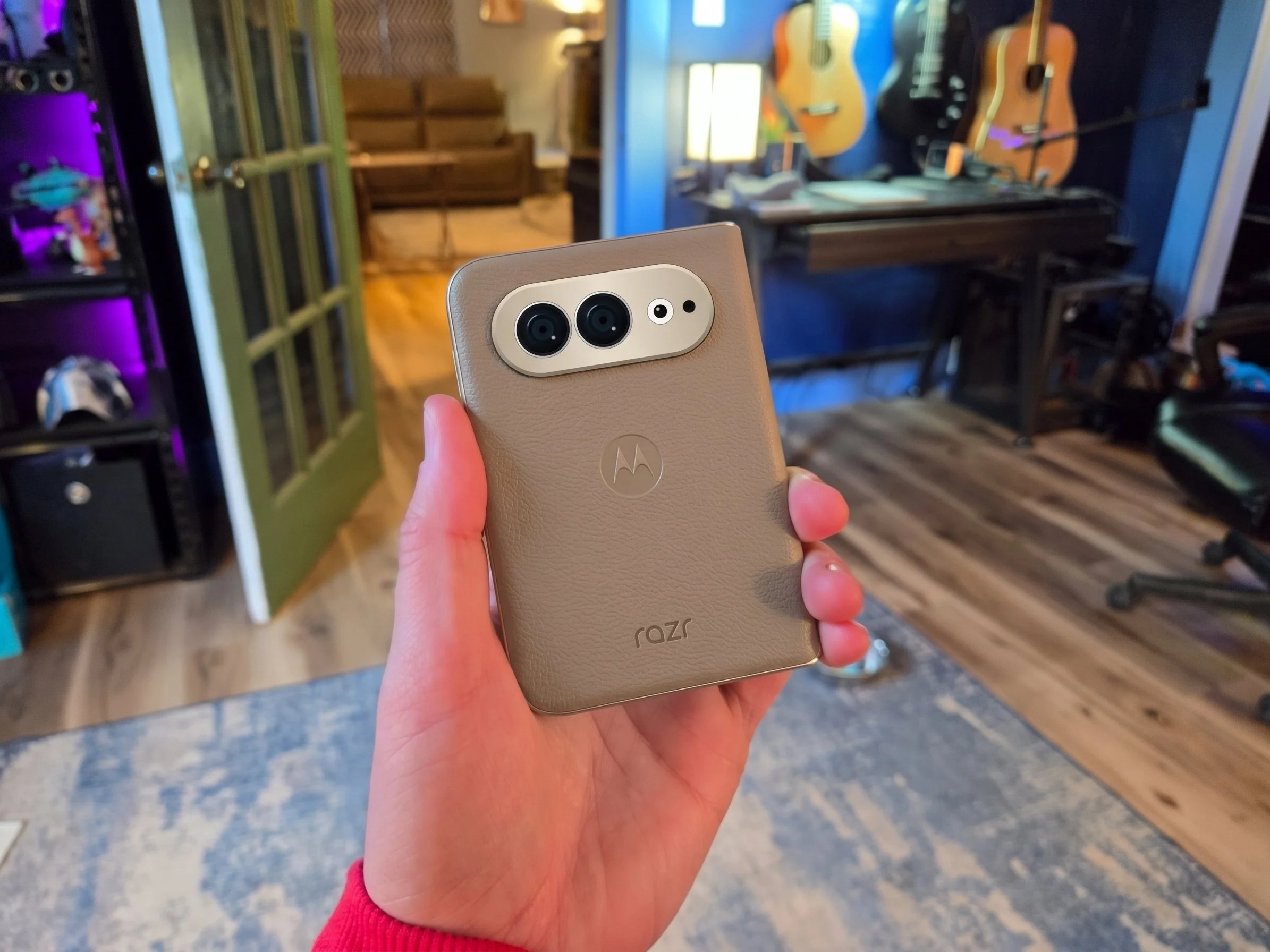
This mock-up shows how small it might be.
The Missing Link in Motorola's Lineup
When you look at the general size of this thing, it becomes clear that Motorola is building out a distinct, middle-ground category. Closed up, the Razr Flex is a surprisingly tiny device. Unfolded, it is slightly shorter than top-flight slab phones like an S26 Ultra or iPhone Pro Max, but noticeably wider.
It sits squarely in the sweet spot between a full-sized book foldable like the Razr Fold and traditional flip phones. Unlike standard flip phones with smaller cover screens interrupted by camera cutouts, the Flex gives you a clean, unobstructed 4.97-inch cover panel that functions as a genuine mini-smartphone screen without cameras in the middle of your content. Once opened, that 6.92-inch inner display expands far beyond what any standard flip phone offers. It functions as a true half-step between a flip and a full fold, delivering passport-style ergonomics in a pocketable footprint.
Calculating the Trimmed Specs
Looking closely at the hardware choices reported by Android Headlines and comparing them directly to the baseline set by the flagship Razr Fold, almost every single step-down targets a major manufacturing cost driver. Instead of matching the Razr Fold's 16GB of RAM and 512GB standard storage tier, Motorola opted for 12GB of RAM and a single 256GB base configuration. Dropping 4GB of memory and cutting the storage capacity in half significantly trims component procurement costs amid tight supply chain margins, without significantly sacrificing day-to-day performance.
It's also worth noting that sticking with the standard Snapdragon 8 Gen 5 processor here is a smart move. On the original Razr Fold, that chip delivered excellent real-world performance without any noticeable hiccup, and it actually kept the device much cooler than most competing foldables on the market.
The display and camera hardware see similar surgical cost reductions. Shifting from the massive 8.1-inch inner canvas and 6.6-inch cover screen on the Razr Fold down to a 6.92-inch inner screen and 4.97-inch outer panel slashes expensive display procurement costs. On the imaging front, periscope telephoto glass is notoriously expensive to source, calibrate, and fit inside a foldable chassis. The Flex drops the Razr Fold's dedicated 3x 50MP periscope module entirely, opting instead for a simpler dual-sensor 50MP array.
Even the power delivery system reflects strategic cost trimming. Stepping down from the flagship's ultra-fast 80W wired and 50W wireless charging to 45W wired and 25W Qi2 allows for less complex power management controllers and simpler internal thermal routing.
How Low Can the Price Tag Go?
When you stack all of these concessions against the $1,899 Razr Fold, Motorola isn't just shaving off $50 or $100 in production overhead, they are potentially stripping out hundreds of dollars in raw component costs.
By dropping down to 12GB of RAM, 256GB of baseline storage, a dual camera array, and smaller displays, a sub-$1,500 starting price is fully within reach. If Motorola chooses to price aggressively on that single 256GB tier, they could potentially shock the market by hitting a $1,199 price floor, finally delivering the affordable, wide-screen passport foldable we were teased with nearly a year ago.