Could the Wide Z Fold 8 Outsell the Standard Model?
Now that Galaxy Z Fold buyers finally have options in terms of phone design, the conversation around Samsung's foldable lineup is getting a lot more interesting. The upcoming Galaxy Z Fold 8 generation is shaping up to give us a legitimate choice between two entirely different form factors.
On one hand, we have the standard model, keeping that familiar, almost square inner display and that tall, narrow cover display. On the other hand, there is a brand new wide variant, which turns the recipe on its head by going significantly wider and shorter, utilizing a 4:3 inner display and a much shorter and wider, almost passport-style, cover display.
No one has really touched this specific passport-style layout since the original Google Pixel Fold, but the market is suddenly moving hard toward these designs. This wide phone exists because Apple has a wide iPhone fold coming, and Samsung is clearly positioning itself to match that exact concept. With two distinct styles on the table, it forces us to look at a question that seemed impossible just a generation ago: could the wide model actually outsell the standard Z Fold 8?
In case the idea of a wide model outperforming the standard Z Fold sounds completely crazy, the early data shows that the demand is absolutely there. I recently ran a poll on my YouTube Community page asking viewers which upcoming foldable they have their eye on, and the results were a total landslide.
More Popular Than You’d Think
Out of 1.1K votes, a massive 57% of people picked the Wide Format Galaxy Z Fold 8. To put that into perspective, the Moto Razr Fold came in second at 20%, the standard Galaxy Z Fold 8 crawled in at just 14%, and the Pixel 11 Pro Fold brought up the rear at 9%.
An overwhelming majority of respondents are actively looking forward to the wider form factor, but we do have to look at these numbers with a bit of a caveat. A YouTube community poll like this isn't a perfect reflection of the general public. My audience is comprised almost exclusively of core tech enthusiasts, the exact crowd that tracks mobile rumors, gets fatigued by the same old designs, and is highly motivated to vote for something new. Because of that enthusiast bias, the standard Z Fold 8 is almost certainly being underrepresented here, as everyday consumers walking into a carrier store often lean toward the familiarity of the standard, established design.
That novelty is exactly why a lot of casual buyers might hesitate. Even though the pool of people spending nearly $2,000 on a flagship smartphone is already less "casual" than the average consumer, dropping that kind of cash on an entirely unproven layout is a tough sell. The standard Z Fold is a known quantity, whereas a short, wide passport style is new, different, and inherently risky to someone who just wants their expensive phone to feel familiar.
Why Wide?
So, why is this unconventional format suddenly gaining so much traction, and what makes it so alluring to the people who are backing it?
The answer comes down to a few, major pain points that some users experience with the traditional foldable that a wider chassis solves in one fell swoop, from everyday usability to the physical layout of the hardware itself.
At its core, the wide variant is a device that is unapologetically built for media consumption. Most traditional foldables try to split the difference with a square inner display, creating a hybrid canvas that ends up as a master of none. Social apps get awkwardly stretched out, and movies are flanked by massive black bars.
When you unfold the Z Fold 8 Wide, the video you see on the screen might only be slightly larger than what you would get on the standard model turned sideways, but the experience is entirely different. It comes down to the lack of letterboxing. For plenty of users, those giant black bars are an absolute eyesore that takes away from the premium feel of a giant screen. For others, it might not be a big deal, but for the crowd that hates letterboxing, this design completely changes the game.
Think about it this way: is there a reason that monitors, TVs, and movie screens have all settled on relatively the same rectangular shape? Of course there is. That aspect ratio is the undisputed king of media, and the Z Fold 8 Wide is finally bringing a similar philosophy to the palm of your hand. It acknowledges that when you unfold a device like this, your brain shifts from phone mode to tablet mode, giving you a true widescreen canvas instead of just a stretched-out handset.
However, there is one bizarre downside to this setup that might ruin the immersion for some. Early design leaks suggest that both of the phone's speakers are located entirely on the left side of the chassis when unfolded. Because a traditional foldable is rotated sideways for videos, it puts a speaker on the left and a speaker on the right to give you true, separated stereo sound. With the Z Fold 8 Wide, you are already holding it in landscape mode. For some reason, Samsung apparently decided to cram both speakers onto the left edge anyway, meaning your audio is going to sound completely lopsided. You won't get true stereo sound out of the hardware unless you throw in a pair of wireless earbuds, which is a frustrating choice for a phone that is explicitly trying to target video consumers.
A moment ago we mentioned apps not necessarily scaling well on that square screen, often leaving you with nothing more than awkwardly stretched-out phone apps. This is where another major benefit of the wide fold comes into play.
You may be thinking to yourself, wouldn't vertically oriented apps be even more stretched out on a wider device? The answer is yes, at least initially. But the magic happens when you rotate the device. Once you turn it sideways, what you have is a canvas much more akin to a standard phone, just scaled up.
This simple rotation is a massive win for those troublesome apps that have completely ignored Google's adaptability push and refused to build proper tablet-friendly layouts. Instead of being forced into a boxy container they were never designed for, these apps can suddenly function much better than they ever would on a traditional square screen.
While the inner screen is obviously the star of the show, the benefits of this form factor stretch right over to the cover display. The biggest win here is genuine, comfortable one-handed usability.
On a normal smartphone, the core dilemma has always been about how big of a screen you want, and the industry answer has consistently been a massive panel. But along with that giant screen comes the automatic sacrifice of one-handed ergonomics. With a wide foldable, you can finally have both. You get excellent one-handed usability on a small, compact cover display that is perfectly sized to handle all the quick, everyday tasks you normally want to do on the go. Then, for that 30% of the time when you actually need as much screen real estate as possible, you can unfold the device and intentionally switch over to a two-handed tablet mindset. It gives you the best of both worlds: a massive canvas when you want it, without permanently sacrificing your ergonomics when you don't.
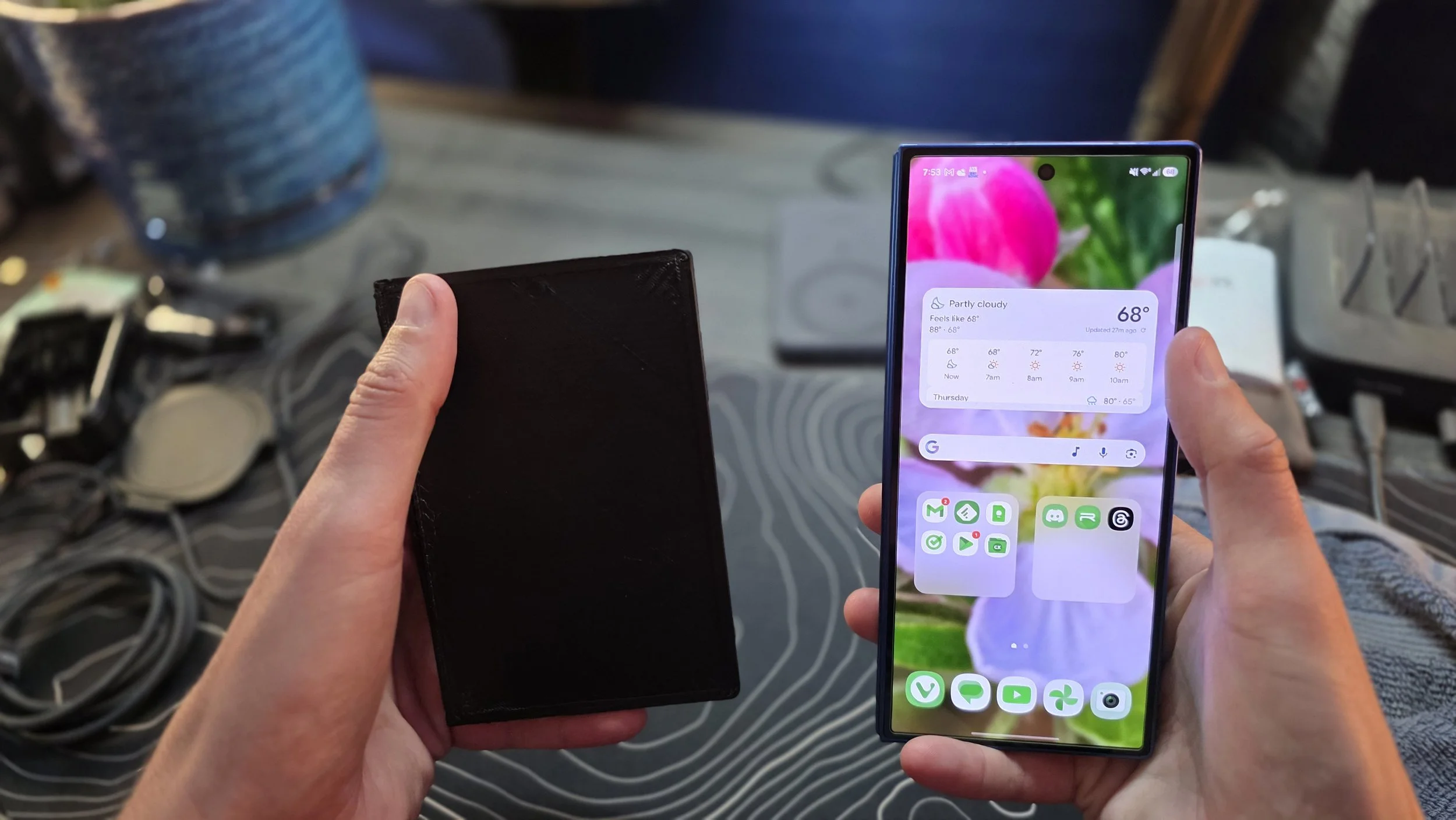
Think about the standard crop of flagship phones right now. It is incredibly difficult for the average hand to reach the top third of a modern smartphone screen without making serious compromises. You either have to rely on software tricks like a dedicated one-handed mode or utility apps, slap a bulky grip accessory onto the back of the device that adds extra weight and thickness, or risk dropping the phone entirely by awkward grip-shifting. Because the Galaxy Z Fold 8 Wide is a shorter device, it flips that dynamic. While it is slightly wider in the palm, its compact vertical footprint means the average hand can easily reach the entire cover display with a thumb.
That shorter footprint also completely changes the game for pocketability, especially when you factor in the rumored 200g weight. My time with the Titan 2 Elite, which has a very similar physical footprint when closed, has made me realize just how much easier a short, wide device is to carry around. It sits naturally, handles the weight beautifully, and honestly leaves me feeling quite strongly that it will be much easier to completely ignore or forget about in a pocket compared to the current tall, bulky slab foldables on the market.
Despite the massive ergonomics and media advantages, the wide variant comes with some clear downgrades that are bound to push a portion of buyers back toward the standard model. When you are shelling out a massive chunk of change for a premium device, you expect the absolute best specs available, and the Wide Fold forces you to accept a few compromises.
First, there is the camera situation. While the standard Z Fold 8 carries over that massive 200 megapixel primary sensor, the wide variant drops that down to a 50 megapixel main shooter. Even worse for photography enthusiasts, the wide model completely removes the telephoto lens. The standard model's zoom capabilities still are not world-class, using that same small 10 megapixel 3x lens yet again, but having some dedicated zoom hardware is vastly superior to having none at all. For a lot of people, the total lack of a telephoto camera on a flagship-tier device is going to be an immediate dealbreaker.
Then you have the battery life. The standard Z Fold 8 is stepping up to a 5,000mAh capacity, but the slimmed-down wide variant drops down to 4,800mAh.
With these hardware regressions on the table, it really places a massive burden on Samsung's pricing strategy. The wide model needs to be cheaper than its sibling to justify the step down in raw specifications. If Samsung lists them at the exact same price point, the average consumer is naturally going to gravitate toward the standard model simply because it offers the better overall spec sheet for the money.
Spec Hunters Might Look Elsewhere
That being said, I do think there is a bit of a monkey wrench in the idea that spec hunters are automatically going to rush out and buy the standard Galaxy Z Fold 8. The power users who want the absolute best hardware package available directly here in the United States have another massive option on the table. Instead of defaulting to Samsung, a lot of them might decide to save $100, skip the carrier store entirely, and pre-order the Moto Razr Fold instead.
We actually saw this sentiment play out clear as day in the community poll, where the Moto Razr Fold completely cleared the standard Z Fold 8, pulling in 20% of the votes compared to Samsung's meager 14%. If you are buying a folding phone purely for the numbers on the box, the Motorola device throws a serious challenge into Samsung's plans. It brings back an active stylus that Z Fold 8 Wide buyers are completely missing out on, and it packs a far superior camera system utilizing much larger sensors across the board. On top of that, it boasts a massive 6,000mAh battery paired with blazing-fast 80W wired charging.
The lone area where the Moto Razr Fold does not explicitly beat out the Galaxy Z Fold 8 is the processor. Samsung's line is heavily rumored to feature the top-tier Snapdragon 8 Elite Gen 5, while the Motorola phone uses the standard Snapdragon 8 Gen 5 Mobile Platform. But let's be real: the vast majority of users are never going to feel that slight performance gap in day-to-day tasks. Plenty of tech enthusiasts will be more than willing to sacrifice a few points on a synthetic benchmark score in exchange for better cameras, a stylus, and a battery that actually lasts.
Apple is Coming
Then there is the upcoming elephant in the room: Apple. Leaks suggest the impending iPhone fold is going to heavily mirror the 4:3 canvas of the Galaxy Z Fold 8 Wide, presenting a book-style layout that is practically an iPad mini when unfolded. If Apple manages to execute this design seamlessly, it could pose a fascinating threat to the status quo. What if an Apple-backed passport device completely validates this shorter, wider shape as the future of the category? If everyday consumers see that layout and decide that is what they want, it might not be the wide model that suffers. Instead, it could cause standard model sales to drop significantly as the traditional, narrow footprint starts to look archaic to the average buyer.
Ultimately, the real curiosity moving into this new generation is how these market dynamics are going to shift. We are no longer just asking whether a wide variant can out-pace a standard model in raw sales numbers. Instead, we are looking at a landscape where the classic, narrow foldable form factor is being challenged on all sides, even internally from Samsung itself. Will we see these wide models step in and immediately sell well with the general public? If they do, it could completely redefine what users expect from a premium folding device, and it will be incredibly interesting to see what that means for the future of smartphone design.